Currently Empty: 0,0000 €
 Audio Components
 Battery Management Systems
 Coils & Transformers
 Capacitors
 Connectors
 Crystals
 Diodes & MOSFETs
 Fuses & Protection
 LEDs
LEDs Optoelectronics
 Power Supplies
 Relays
 Resistors
 Switches
  Terminal Blocks
  Tools
Tools Wires & Cables
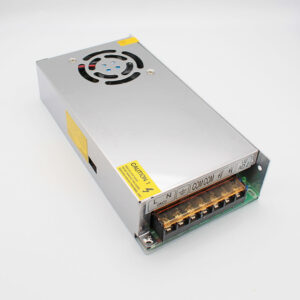
A switching power supply, also known as a switch-mode power supply (SMPS), is an electronic device that converts electrical power efficiently from one voltage level to another. Its main purpose is to provide a stable output voltage while minimizing energy loss.
Unlike traditional linear power supplies, a switching power supply works by rapidly turning an electronic switch on and off at high frequency. This process controls how much energy is transferred to the output, allowing the supply to step voltage up or down as needed. Because the regulating components operate in switching states rather than continuously dissipating power, switching power supplies are much more efficient and generate less heat.
Switching power supplies are widely used in modern electronics, including computers, phone chargers, televisions, industrial equipment, and LED lighting. They can operate over a wide range of input voltages and are available in various designs, such as buck (step-down), boost (step-up), and buck-boost converters.
In simple terms, a switching power supply efficiently converts and regulates electrical power, making it an essential component in many electronic devices.